Results
This section presents the results of the conceptual content analysis for each data group in order to better understand to what extent mid-tier resource organisations in Western Australia include sustainability reporting in their social media communications to stakeholders.
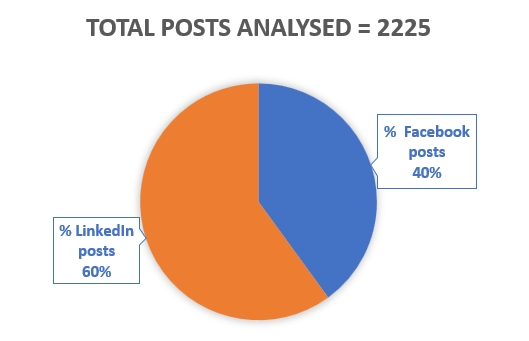
Of the 2225 social media posts analysed, 1330 were LinkedIn posts, which equates to 60%, and 895 were Facebook posts, which equates to 49%. This can be due to LinkedIn being a professional network, where more of the regulatory reporting and investor related information was found.
Sustainability reporting related communication results
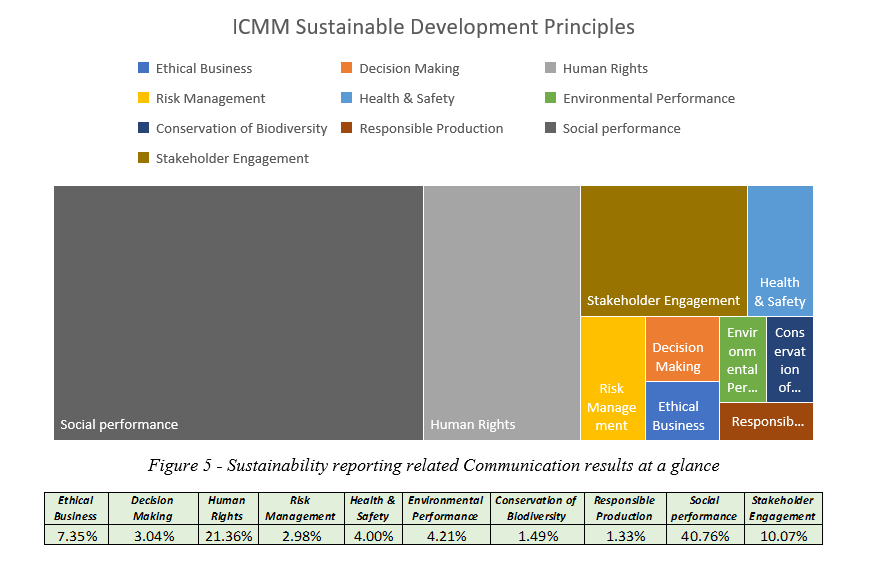
Sustainability data was based on performance expectations related to ethical business and decision-making practices, human rights, stakeholder perceived risk management, health and safety protocols, environmental performance, conservation of biodiversity, responsible production and recycling, social performance, and direct engagement with stakeholders.
Results for sustainability reporting data on the two platforms found empirical evidence that the majority (40.76%) related to the organisation’s social performance, with company philanthropy being the preferred topic, followed by financial or equipment support for local schools and sporting clubs, and employment opportunities within the local community. Human rights related posts accounted for 21.36% of posts with a reasonably even distribution of diversity program, gender equality and employee appreciation posts. Direct stakeholder engagement posts accounted for 10.07% of posts with many promoting site tours and mentoring programs.
At the lower end of the scale, only 1.33% of posts were related to responsible production and 1.49% to conservation of biodiversity. Environmental performance ranked low at 4.21%. Health & safety and risk management jointly accounted for 6.98% of posts with ethical business and decision-making ranking slightly higher at 10.39% of posts.
Communication style results
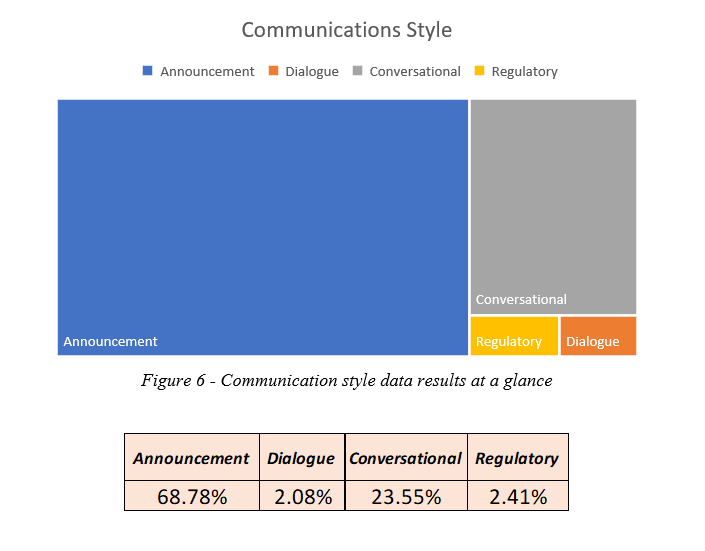
Communication style data was based on announcements, dialogue with stakeholders, conversational posts and regulatory reporting.
Results of data analysis over the two platforms found empirical evidence that over 95% of posts were either announcements at 68.78% or conversational at 23.55%. Announcements included topics such as operational activities, senior staff engagements, press releases and new site development or site closures. Conversational posts were limited to congratulatory posts, including competitors and local community groups, and seasonal posts such as Merry Christmas or Happy Hanukkah and thank you posts.
At the lower end of the scale, regulatory posts including annual reports and investor reports made up just 2.41% of posts, with dialogue ranking as the lowest style of communication used at 2.08% of total posts. The low dialogue percentage appears to support previous research that many Australian mining companies prefer push communications in their online sustainability reporting as a perceived method of reducing the risk of negative backlash through open dialogue (Frederiksen, 2018; Amoako, Lord, & Dixon, 2017).
Audience data results
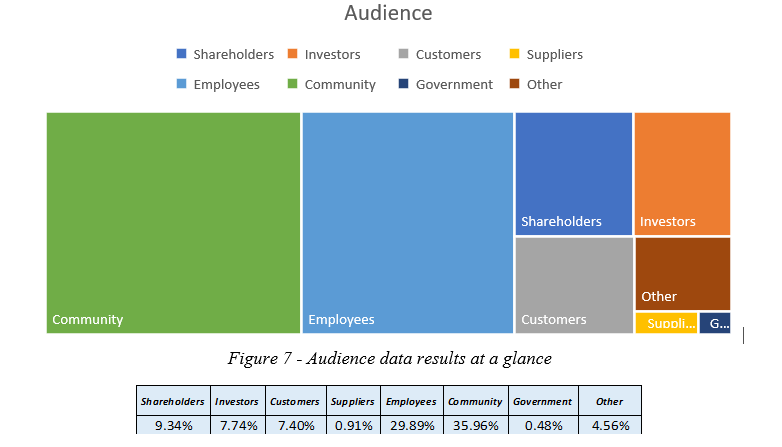
The audience data was based on the stakeholder focus of the post, these included Shareholders, potential and current investors, customers, suppliers, current and potential employees, local and wider community and government.
Results revealed empirical evidence that community focused posts accounted for 35.96% of sustainability related posts with community philanthropy being the most prevalent topic communicated. Other predominant community focused posts included promotion of community events, and employment opportunities both local and interstate. Employee focused posts accounted for 30.5% of sustainability posts over the 2 platforms, followed by customer focused posts at just over 8%. Customer focused posts entailed communicating opening times, COVID precautions, and changes of contact details.
Posts focused on shareholder and investors were predominant on LinkedIn with investor reports, ASX reports and operational targets being the most common topics. Shareholder and investor posts accounted for 17.08% of posts. At the low end of the scale posts focused on suppliers accounted for less than 1% of posts.
Filler (other) posts accounted for 4.56% of total posts, which demonstrates that 151 posts analysed were purely symbolic, had no bearing on the organisation or its stakeholders and were of no value. Prior research into stakeholder theory provides empirical evidence that all communications to stakeholders should have value to direct or indirect stakeholders to be worthwhile distributing (Carroll, Brown, & Buchholtz, 2020), (Manetti & Bellucci, 2016).