

Methodology
Research Design
This study uses netnography (Kozinets, 2019) to examine the extent of sustainability reporting on social media with an ontological approach applied to the qualitative grounded theory study. Using a conceptual content analysis research strategy (McGowan, 2014), a qualitative analysis was done on a random sampling of Chamber of Mines and Energy Ordinary mid-tier members’ social media communications posted over a two year period.
Netnography is described as a distinct set of actions applied to social media qualitative research. Netnography draws on ethnography, in understanding social interactions in a contemporary digital communication context (Kozinets, 2019).
The methodology of a research study is important as it reveals the choices applied by the researcher to the research design, concepts, approaches as well as methods employed for data collection, analysis, and interpretation.
In this study, using an ontological approach to the research ensured rigor in allowing the author to identify with certainty the nature and existence of the phenomenon being researched. For example, ontology allowed the author to assess the legitimacy of what is ‘real’ in the study and how to approach conflicting ideas of this reality?
Research Methods
A conceptual analysis (McGowan, 2014) using inductive reasoning (Swann, 2021) was used to study the phenomenon of sustainability reporting by quantifying and counting its presence in social media data. This was achieved by examining the occurrence of selected themes in the data.
Using the International Council on Mining and Metals (ICMM) 2020 sustainable development framework principles, Facebook and LinkedIn communications from 01/012020 and 31/12/2021 were analysed on 29 mid-tier resource organisations based in Western Australia. The author focused on the communication trends of the organisations to reveal patterns in the content.
Participant Sample
A randomised sample of 28 mid-tier organisations was selected from a population of 65 Chamber of Mines Ordinary Members. It is important to note that the sample population was selected from the Chamber of Mines Ordinary Members as members have to be based in Western Australia, represent a subsidiary company based Western Australia or supply a service to a resource company in within Western Australia.
Researching a sample size of 28 in relation to the population size of 65 with a confidence interval of 15 achieves results with a 95% confidence level. Results of the research are not necessarily indicative to national, global, or emerging resource organisations and confidence levels could change with future studies including these organisations.
It is generally accepted wisdom that large organisations with a social media presence mostly have dedicated teams managing the communications released on these platforms whereas mid-tier organisation social media platforms tend to be managed by one person, as task secondary to their main duties. This difference in social media management leads to a substantial difference in quantity and content of social media posts, which would result the skewing of mid-tier organisation results. For this reason, it is important for rigor in the study that like participants are the subjects of the research.
Scope
The research involved a longitudinal study of participating organisations’ social media posts over a period of two years from 12:00am on 01/012020 to 11:59pm on 31/12/2021 using temporal data traces.
While most social media platforms date stamp posts, those social media data that are not time stamped can be mined using digital temporal traces for temporal insights. Temporal insights include notable events, initial emergence of a phenomena, current societal dynamics, or future trajectory information. Temporal analysis of data is also described as time-series analysis, which is a technique applied by researchers for analysing data units that can change over time (Kozinets, 2019).
As social media is a nested entity (Thomas, 2020) with multiple levels. This study focuses on analysing data on social media at a macro level by analysing page owner posts as opposed to the micro level data that consists of interactions between individuals such as social media comments, likes, and shares. The study does however take into account that group dynamics collectively develop into the macro-data point.
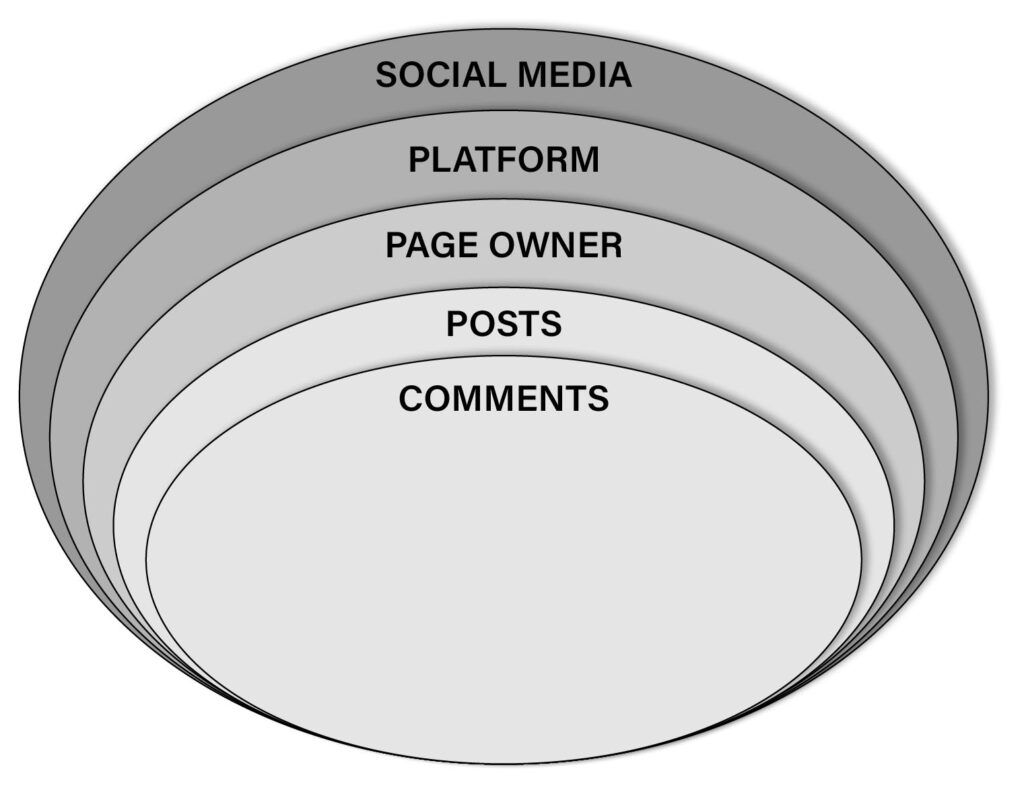
The data in the research are bounded at platform level with units of observations constrained to page owner and page owner posts. Units of analysis in the research are the Facebook socially aligned platform and the LinkedIn business aligned platform.
The phenomena of sustainability reporting by resource organisations occurs across the platforms being researched and can be evenly compared across both platforms as the cultural norms that govern practices on both Facebook and LinkedIn are equal.
The data in the study are geographically bounded in Western Australia. The geographic slant of the data are identified by means of explicit profile references to locations, semantic information embedded in posts such as location tagging, and inter-location information such as photographs, videos and locations explicitly mentioned in posts.
Ethics
The study used publicly available data, on social media platforms where the majority of users are 18+ years of age (adult audience). The topic researched was not of a sensitive nature and contained publicly available corporate data only (macro-level data), not individual level data (micro-level data).
The necessary insights for the study can only be obtained through corporate social media platforms, and aggregate findings were sought rather than individual-level insights, i.e.: the observation of public corporate behaviour within a broader online narrative. Every care was taken to protect any identifying information as such information is of no relevance to this study.
According to Ravn, et. al. (2020) a researcher does not need informed consent to access publicly accessible data. Even though the ethics of social media research is still an emerging debate amongst academics and scholars, there is a preference to adhere to technical notions of “publicly available data” when developing research standards and applying for ethics approval to conduct research on social media platforms. Based on the assumption that users of social media, whether individuals or organisations, have consciously published content in the public domain, it can be argued that this “consent waiver” approach paves the way for widespread mining, collection and analysis of social media content as empirical data.
Coding
The data analysed in the study is to provide insights into the research sample’s sustainability and environmental disclosures on social media over a two-year period. The collected data was coded using a descriptive coding method allowing the researcher to eliminate any data not sustainability related.
Using the ICMM sustainable mining principles (ICMM, 2020), stakeholder definitions by Carroll, et. al. (Carroll, Brown, & Buchholtz, 2020) and generally accepted definitions of social communication styles, a pre-defined set of categories was developed. The pre-defined categories were inflexible allowing the researcher to stay focused on examining the data for a defined phenomenon. Coding sheets were developed in Excel based on these pre-defined categories.
ICMM Sustainable Development Performance Expectation Principles
As the social, environmental, and governance demands on industry become more complex it became apparent that there is a need for consistency when it comes to sustainability management and reporting in the mining industry. In 2018, the International Council for Mining & Metals (ICMM) instigated a global consultation on introducing a comprehensive catalogue of sustainable development principles including the performance expectations of resource companies to manage a range of sustainability issues at a governance and operation level (ICMM, 2020).
In 2020, a list of ten sustainable development principles that align with the United Nations 2030 Sustainable Development Goals (UN, 2020) as well as other responsible resource sourcing initiatives was published on the ICMM website and released to all ICMM members (ICMM, 2020).
The ICMM principles allow for the exploration of how responsibly resources are being harvested and managed, from ethical business practices to responsible production by defining best practice expectations for environmental, social, and corporate governance in the mining industry.
When adopted by an organisation, the ICMM sustainable development performance expectation principles strengthen its governance on social issues such as human rights, diversity, resettlement, traditional land owner’s rights and access to grievance systems. The principles also assist organisations in regulating administration of environmental concerns such as pollution and waste management, recycling, mine closures, and land restoration.
| ICMM Sustainable Principles Performance Expectations | ||
| Ethical Business | Relating to ethical business practices and sound systems of corporate governance and transparency to support sustainable development | Maintain compliance with applicable law.Prevent bribery, corruption and publicly disclose facilitation payments.Implement policies and standards consistent with the ICMM policy framework.Assign accountability for sustainability performance at the Board and/or Executive Committee level.Disclose value and beneficiaries of financial and in-kind political contributions |
| Decision Making | Relating to corporate strategies and decision-making practices | Integrate sustainable development principles into corporate strategy and decision making in the design, operation, and closure of facilities.Adopt responsible health and safety, environmental, human rights and labour policies and practices, based on risk. |
| Human Rights | Relating to the interests, customs, cultures and values of employees and communities affected by the organisation’s operations | Respect human rights.Avoid involuntary physical or economic displacement of families and communities. Implement a human rights and security approach.Respect the rights of workers.Remunerate employees with wages that equal or exceed legal requirements.Respect the rights, interests, aspirations, culture, and natural resource-based livelihoods of Indigenous Peoples in project design, development, and operation.Obtain the free, prior and informed consent of Indigenous Peoples where significant adverse impacts are likely to occur.Implement policies and practices to respect the rights and interests of women. Support diversity in the workplace. |
| Risk Management | Relating to the implementation of effective risk management strategies and systems based on sound science and which account for stakeholder perceptions of risk | Assess environmental and social risks of new projects and significant changes to existing operations in consultation with affected stakeholders.Undertake risk-based due diligence on conflict and human rights whenoperating in a conflict-affected or high-risk area.Implement risk-based controls to avoid, prevent, minimise, mitigate or remedy health, safety and environmental impacts to workers, local communities, cultural heritage and the natural environment.Develop, maintain, and test emergency response plans. |
| Health & Safety | Regarding the pursuit of continual improvement in health and safety performance with the ultimate goal of zero harm | Implement practices aimed at continually improving workplace health and safety.Monitor performance for the elimination of workplace fatalities, serious injuries, and prevention of occupational diseases.Provide workers with training in accordance with their responsibilities.Implement health surveillance and risk-based monitoring programmesbased on occupational exposures. |
| Environmental Performance | Regarding the pursuit of continual improvement in environmental performance issues such as water stewardship, energy usage and climate change | Plan and design for closure in consultation with relevant authorities and stakeholders.Implement measures to address closure-related environmental and social aspects.Implement water stewardship practices to achieve responsible and sustainable water use.Design, construct, operate, monitor, and decommission tailings using comprehensive, risk-based management and governance practices.Apply the mitigation hierarchy to prevent pollution, manage releases and waste, and address potential impacts on human health and the environment.Implement measures to improve energy efficiency and contribute to a low-carbon future, and report the outcomes based on internationally recognised protocols for measuring CO2 equivalent (GHG) emissions. |
| Conservation of Biodiversity | Regarding the contribution to the conservation of biodiversity and integrated approaches to land use planning | Neither explore nor develop new projects in World Heritage sitesRespect legally designated protected areas.Design and operate any new operations or changes to existing operations to be compatible with the value for which the areas are designated.Assess and address risks and impacts to biodiversity and ecosystem services with the ambition of achieving no-net-loss of biodiversity. |
| Responsible Production | Regarding the facilitation and support of knowledgebase and systems for responsible design, use, re-use, recycling and disposal of products containing metals and minerals | Implement cost-effective measures for the recovery, re-use or recycling of energy, natural resources, and materials. Assess the hazards of the products of mining according to UN Globally Harmonised System of Hazard Classification and Labelling or equivalentCommunicate hazards of products through safety data sheets and labelling. |
| Social Performance | Regarding the pursuit of continual improvement of social performance and contribution to the social, economic, and institutional development of host countries and communities | Implement inclusive approaches with local communities to identify their development priorities and support activities that contribute to their lasting social and economic wellbeing,Enable access by local enterprises to procurement and contracting opportunities.Provide local stakeholders with access to effective mechanisms for seeking resolution of grievances related to the company and its activities.Collaborate with government to support improvements in environmental and social practices of local Artisanal and Small-scale Mining (ASM). |
| Stakeholder Engagement | Relating to the proactive engagement of key stakeholders on sustainable development challenges and opportunities in an open and transparent manner as well as the effective reporting and independently verifying progress and performance thereof | Identify and engage with key stakeholders on sustainable development issues in an open and transparent manner.Publicly support the implementation of the Extractive Industries Transparency Initiative (EITI).Report annually on economic, social, and environmental performance at the corporate level using the GRI Sustainability Reporting Standards.Conduct annual independent assurance of sustainability performance. |
Table 1 – ICMM Sustainable Principles Performance Expectations
Source: (ICMM, 2020)
Communication style
Social communication entails using different forms of language that match the given situation. These can be many and varied. For this study the author used communication terms generally accepted by society as communication actions taken by individuals or organisations to communicate or interact with others within a societal network.
| Communication Style | |
| Announcement | Posts containing a formal public statement about a fact, occurrence, or intention directly related to the organisation. |
| Dialogue | Posts that generate or actively seek feedback from stakeholders |
| Conversational | Posts not related to the organisation or posts containing a symbolic gesture. (eg, thank you, merry Christmas, etc) |
| Regulatory | Posts that follow state, federal, and international laws and regulations relevant to the organisation’s operations |
Table 2 – Communication style
Stakeholder audience
The basis for deciding which stakeholders to include in the study was drawn from multiple sources, specifically Carroll, et. al. (2020) where they identify numerous groups in a pluralistic society, like Australia, that can be identified as a stakeholder. Within these groups a shareholder is defined as a owner stakeholder, whereas an investor is classed as a non-owner financial stakeholder. Direct stakeholders include shareholders, customers, and employees, while indirect shareholders include suppliers, investors, communities and government.
| Stakeholder Audience | |
| Shareholders | A person, company, or institution that owns at least one share of the organisation’s stock |
| Investors | Any person, business or mutual fund that commits or is likely to commit capital with the expectation of receiving financial returns |
| Customers | Any person or company that purchases goods or services from the organisation |
| Suppliers | Any person or business that provides a product or service to the organisation |
| Employees | Anyone who gets paid a wage or salary to work for the organisation |
| Community | Any person or business directly affected by the organisation’s operations |
| Government | Australian local councils and state or federal government departments |
| Other | Any other person or business that does not fit into one of the above categories or has an additional characteristic not covered in the above categories. E.g., sport fan, student, grant recipient, etc. |
Table 3 – Stakeholder Audience
Source: (Carroll, Brown, & Buchholtz, 2020)
Data collection and analysis
Data were collected from public social media posts on participating organisation’s Facebook and LinkedIn newsfeeds from 12:00am on 01/01/2020 to 11:59pm on 31/12/2021. Data is considered public on social media platforms when the user controls the data visibility and the data already exists in the public setting (Thomas, 2020). Currently, there is no set of rules or standards on the ethical collection of public data from social media. Nevertheless, it is generally agreed that there are 4 unwritten rules to working ethically with social media data.
- Do good;
- Do no harm;
- Be respectful; and
- Treat people and organisations fairly.
At the time of planning the research, data mining was allowed on Facebook pages with a public setting. At the time of data collection, Facebook had been restructured under the Meta brand and the ability to engage in data mining on all Meta owned social media platforms had been withdrawn. However, according to the updated Facebook Terms and Conditions, manual data collection is allowed on profiles or pages that have a public setting.
According to the LinkedIn End User Agreement, using data mining software to mine data from LinkedIn company profiles is currently prohibited. However, manually gathering data from organisations who have a public profile is allowed (Quora, 2020).
In the data collection phase of the study, the researcher manually read and interpreted the social media posts of the participating organisations and analysed them against the ICMM performance expectations under each sustainable development principle. If a post was deemed to have met the criteria for a performance expectation, a X was placed in the relevant sustainable development principle column. The researcher then compared the language style used to communicate the information with the communication style on the coding sheet where an X was placed under the relevant column. The third and last action the researcher took per post was to assess which stakeholder the communication was targeting and placed an X in the relevant stakeholder group column on the coding sheet. This series of actions was repeated on all public posts over a two year period for all participating organisations.
During data collection and coding for the existence of sustainability reporting, the researcher counted the posts containing sustainability reporting data each time they appeared in the participants newsfeed, even where posts were duplicated in the newsfeed or across platforms. Data was mined manually by the researcher using set conditions as per the coding sheet and analysed in Excel.
Once all the data was collected and entered onto the coding sheets, the participant summaries were integrated onto one sheet for analysis purposes and analysed using an inductive approach. In doing this, the researcher started the analysis with no prior bias as to the outcome. The data was collected and analysed for patterns using Excel data analysis techniques, in order to develop a hypothesis.