
Theoretical Framework
Tullberg (2013) suggests stakeholder theory currently implies that to be considered a stakeholder, a significant contribution is to be made to the company, but a stakeholder can also be part of the company’s output. However, a number of studies, specifically Carroll, et. al. (2020), argue that, in a pluralistic society, an organisation’s stakeholders can be any individual or group. Caroll, et. al. (2020) go on to hypothesise that from an organisation’s perspective, a direct stakeholder is an individual or group that has a direct interest in, or claim on, the organisation or its operations. Management tends to perceive direct stakeholders such as shareholders, employees and customers as having more legitimacy than indirect stakeholders (Carroll, Brown, & Buchholtz, 2020), (Laczniak & Murphy, 2021).
However, from a pluralistic society’s viewpoint an organisations stakeholders include not only direct stakeholders but other groups as well. These groups include traditional land owners, suppliers, competitors, communities, the media, special-interest groups and even the environment itself (Carroll, Brown, & Buchholtz, 2020). A pluralistic society is a macroenvironment consisting of business and societal relationships that are complex and dynamic with a diffusion of power among the many groups and organisations the macroenvironment encompasses (Höffe, 2015).
Stakeholder engagement
Stakeholder engagement can be defined as a two-way relationship that exists between an organisation and its stakeholders, where each have the ability to have a positive or negative impact on the other (Kaur & Lodhia, 2018). However, at the same time, they accept that there is limited research investigating the methods and digital platforms employed by organisations to establish and foster stakeholder relationships and engage stakeholders regarding sustainability activities and concerns. Understanding these methods is valuable to organisations for risk mitigation where stakeholders can affect their organisational strategies and activities.
Stakeholders with a localised sense of community are more apt to initiate dialogue with local organisations regarding environmental and sustainability concerns that directly impact the region they live in (Forsyth, van Vugt, Schlein, & Story, 2015). However, Carroll et al. (2020) argue it is not only the local community concerned with an organisation’s environmental or societal impact, but environmentalists that have a high power to influence ratio, regardless of where they themselves reside, are uniting with each other and mass media outlets to protect the world’s resources (Carroll, Brown, & Buchholtz, 2020).
Of the five distinct classifications of stakeholder powers, in the digital sphere informational power has become a primary consideration when communicating with both direct and indirect stakeholders (Lambert, 2019). Stakeholders have information power when they access large amounts of publicly available facts, details, and data that they can use to bring their own agenda to the public’s attention (Carroll, Brown, & Buchholtz, 2020). With the shift of sustainability reporting from traditional to digital communications, activists can use this extraordinary power to change company policies, disrupt operations or even close down projects.
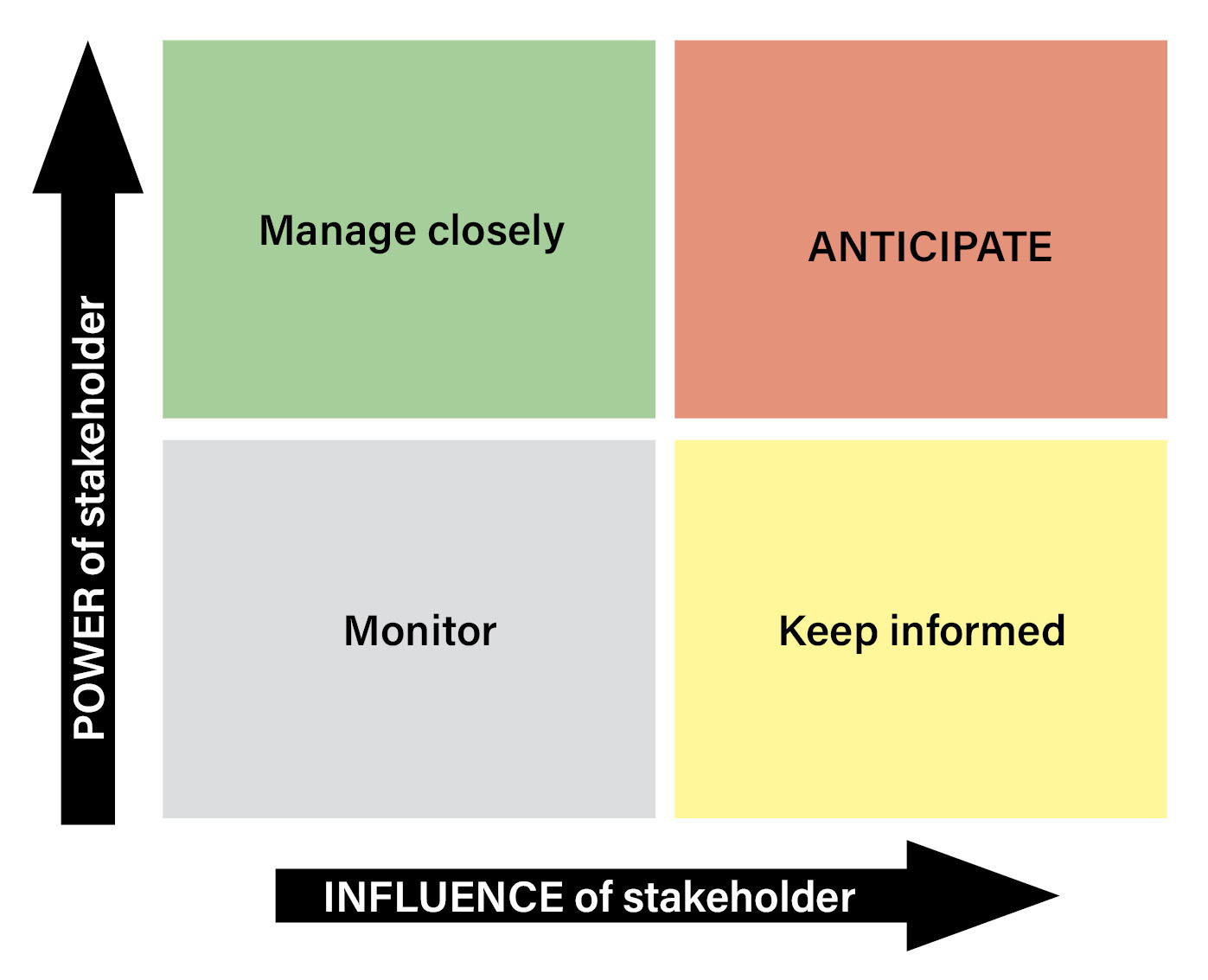
Organisations have the ability to anticipate a stakeholder’s likelihood of affecting its corporate strategies and operations by using the Power to Influence matrix (Persson & Olander, 2022). The stakeholder that displays a high influence over other stakeholders or the organisation itself and has a high information power needs to be managed and engaged with differently to the stakeholder who has low information power and stakeholder influence.
In the sustainability reporting process, stakeholder communication and engagement that is responsive, transparent, and accountable can reduce information power risk by demonstrating a willingness to address stakeholder concerns (Kaur & Lodhia, 2018). Regardless of the research, the majority of Australian mining companies prefer push communications in their online sustainability reporting as a perceived method of reducing the risk of negative backlash (Frederiksen, 2018; Amoako, Lord, & Dixon, 2017), a practice which can compound a problem rather than avoid it.
Stakeholder perceptions and outrage culture
From the organisation’s perspective, stakeholder sustainability problems are the gap between the stakeholder’s expectations of sustainability performance and the organisation’s actual sustainability performance (Carroll, Brown, & Buchholtz, 2020). Grey literature suggests stakeholder sustainability problems leading to outrage culture can be described as the gap between the stakeholder’s perception of an organisation’s sustainability performance and their expectations of the organisation’s sustainability performance. The higher the stakeholder expectation, the more the risk of outrage becomes. See Figure 2 – Sustainability performance to outrage.
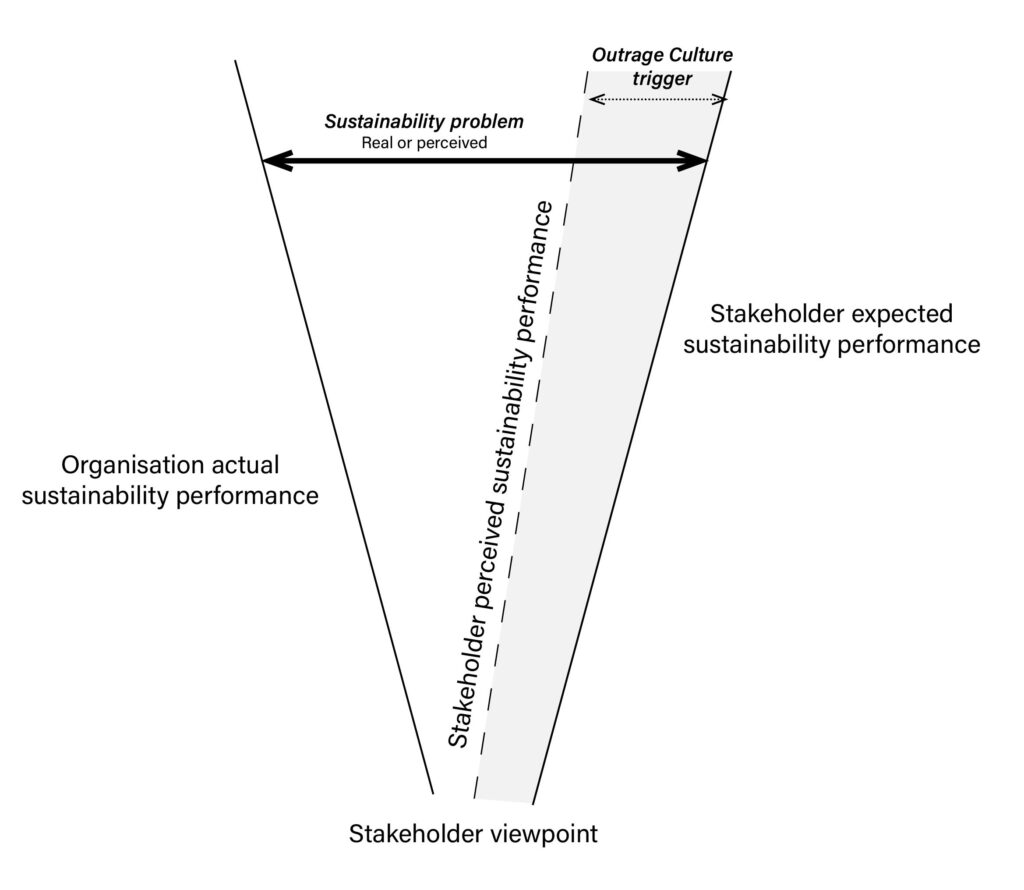
To date, there has been no academic research into the phenomenon of Outrage Culture and its effects on organisations in a pluralistic society. Grey literature is full of opinions and narratives relating to historical and current events and the onset of Outrage Culture on social media. Carroll, et. al (2020) come close to discussing the phenomenon in their text about social problems by noting that rising stakeholder expectations typically outpace actual performance by organisations leading to digital shaming and online criticism.